

Introduction
Every small and mid-sized business now runs on data. Orders sit in an ERP, customers in a CRM, finance in spreadsheets, and documents in SharePoint. Leaders know AI could turn that data into faster answers and fewer manual tasks.
The complication is that SMBs rarely have the time, budget, or headcount for a multi-year platform program. Most have tried a dashboard here and a chatbot there, and neither scaled. So the real question is not whether to modernize, but how to do it fast enough to matter without betting the business.
Our answer: Microsoft Fabric as the unified data foundation with Microsoft Foundry as the governed AI factory, delivered through a disciplined 90-day Data Modernization & AI roadmap. This blog makes the case for that combination, lays out the roadmap phase by phase, and is candid about the trade-offs you should weigh before you start.
Why SMB Data and AI Efforts Stall?
The problem is rarely ambition. It is fragmentation. Data lives in disconnected tools, each with its own copy, definitions, and access rules. When two reports disagree on revenue, trust erodes and decisions slow down.
AI makes this worse, not better. An AI assistant is only as reliable as the data it is grounded on. Point it at messy, duplicated, or ungoverned data, and it produces confident answers no one can verify. That is how promising pilots get stuck in "pilot purgatory": impressive in a demo, unsafe in production.
The business consequence is a growing gap. Larger competitors are already using AI to quote faster, forecast better, and serve customers around the clock. SMBs that keep stitching together point tools pay twice: once in licenses and integration effort, and again in decisions made on stale or inconsistent numbers. That is why Data Modernization & AI works best as one program, not two separate projects.
Why Fabric + Foundry is the Right Pairing?
The claim is simple: SMBs need one data foundation and one AI factory, and they need the two to work together by design. Fabric and Foundry are built to do exactly that.
Microsoft Fabric brings data engineering, warehousing, real-time analytics, and Power BI onto a single SaaS platform. Its OneLake storage layer uses shortcuts and mirroring to create one logical view of your data, often without building or running copy pipelines.
Microsoft Foundry is Microsoft's platform for building AI agents and apps. It brings a broad model catalog, agent hosting, tools, tracing, and evaluation under one Azure resource, governed with Entra identity, role-based access, and Azure Policy.
The reasoning lies in the connection. Foundry agents can use Fabric IQ as a tool to ask business questions of Fabric data, and OneLake files can serve as Foundry knowledge sources. Fabric permissions are honored along the way, so agents see only what a user is allowed to see.
| Dimension | Piecemeal tools | Fabric + Foundry |
|---|---|---|
| Data storage | Separate copies in each tool | One logical lake (OneLake) with shortcuts and mirroring |
| Business definitions | Redefined in every report | Shared semantic models and a business ontology |
| AI grounding | Ad-hoc uploads and exports | Agents query governed Fabric data directly |
| Security | Rules set per tool | Fabric permissions and Entra identity carried through to agents |
| Model choice | Locked to one vendor's AI | A broad catalog, matched to each task |
| Monitoring | Little or none | Tracing, evaluation and cost tags built in |
| Path to scale | Rebuild for every new use case | Reuse the same data, tools and guardrails |
The 90-day Roadmap, Phase by Phase
The approach is to deliver value in three 30-day phases, each ending at a go/no-go gate. You never invest further without evidence that the previous phase worked.
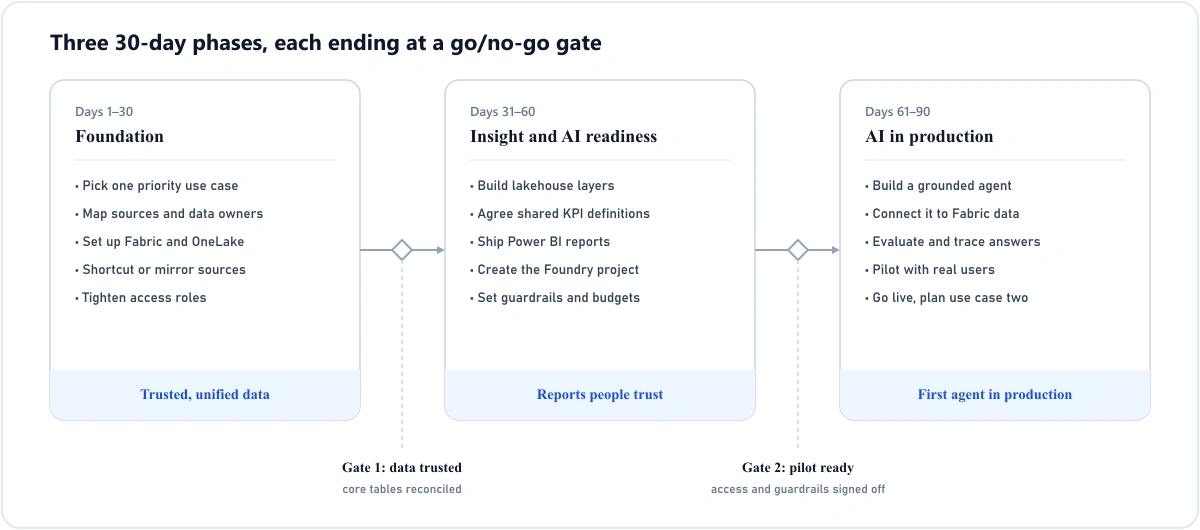
- Days 1–30: Foundation. Choose one business problem worth solving, such as faster quoting or a reliable sales forecast. Bring the sources it needs into OneLake through shortcuts or mirroring, and fix access roles before anything else is built on top.
- Days 31–60: Insight and AI readiness. Shape raw data into clean lakehouse layers, agree on one definition for each KPI, and give users Power BI reports they trust. In parallel, set up the Foundry project with identity, content filters and budgets in place from the start.
- Days 61–90: AI in production. Build an agent grounded in your Fabric data, test it against real questions, trace its answers, and pilot it with a small group before going live.
The sequencing is the evidence. Microsoft's own guidance for Foundry stresses starting with one concrete problem and configuring governance at creation, not later. The roadmap simply builds both principles into the calendar.
Guardrails and Trade-offs to Weigh
A credible roadmap is honest about its limits. Three trade-offs deserve attention before you commit.
- Permissions come before agents. Agents inherit the access of the people who use them. If workspace and OneLake security roles are loose today, an agent will expose that looseness. Clean up access in the first 30 days, not after launch.
- Not every feature is production-ready. Parts of the stack, including the Fabric IQ ontology and the Fabric IQ tool for Foundry agents, are still in preview. Use generally available capabilities for core processes, and keep preview features in clearly scoped pilots with a named owner.
- Cost needs a model, not a guess. Fabric capacity, model inference, agent hosting, and search all add up differently. Set budgets and cost tags from day one, choose smaller models for simple tasks, and pause or right-size capacity outside working hours where possible.
None of these is a reason to wait. Each is a reason to follow a structured plan with governance designed in, rather than bolted on later.
What Do You Own at Day 90?
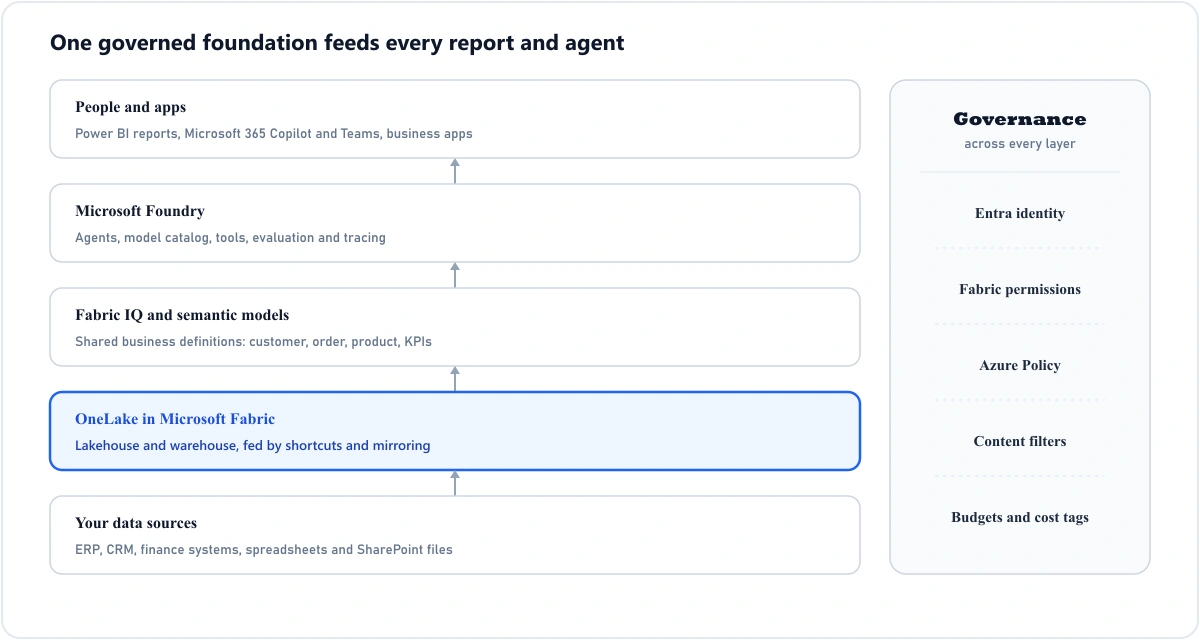
The value compounds from here. Your second agent reuses the same OneLake data, the same business definitions and the same Foundry guardrails as your first, so it is faster and cheaper to deliver. Each new data source added to OneLake makes every report and agent smarter at once.
Conclusion
SMBs do not need a bigger AI budget. They need a clearer sequence: unify the data, govern it, then put AI to work on it. Fabric gives you the single foundation, Foundry gives you the governed AI factory, and a 90-day roadmap keeps the effort focused on one measurable business outcome at a time.
The most important step is choosing the right first use case and getting the foundation right the first time. If you want an experienced partner to assess your data estate, shape that first use case, and run the 90 days alongside your team, explore how Vortiqo's Data & AI services help SMBs move from scattered data to production-ready AI.

Deepak Chaudhary
Cloud Strategy and Transformation Leader
Deepak Chaudhary is a Cloud Strategy and Transformation Leader at Vortiqo Technologies, helping SMBs scale smarter through cloud-led innovation. With a background in Information Technology, he focuses on aligning cloud transformation initiatives with strategic business outcomes.