

Introduction
The AI gap is a trust gap. Most small and mid-sized businesses (SMBs) no longer need convincing that AI matters. What they need is a way to make it work beyond the demo. The distance between those two things is wide, and it is growing. The State of AI 2025 report found that nearly half of companies with more than $5 billion in revenue have reached the AI scaling phase. Among companies under $100 million, just 29% have. The large firms are not winning because they have better models. Today, every business can reach the same frontier models in a few clicks.
The difference between the rapid scalers and the stalled is less glamorous: data the business can trust, and controls that prove an AI system behaves as it should. Large enterprises build both with dedicated data and risk teams. Most SMBs cannot.
In this blog piece, we will discuss the business case for Microsoft Foundry and its unified platform for building, deploying, and governing AI apps and agents on the data a business already owns. Its real value for SMBs is not that it makes agents possible. Many tools do that. It is that Foundry makes governed agents the default, so a small IT team can run AI with the discipline of an enterprise.
What is the Real Bottleneck?
Data and the level of control that an organization can exercise over it are the real bottleneck to building, deploying, and governing AI apps and agents. An AI agent is only as good as the data it can reach and the rules it must respect. When either is missing, the agent gives confident wrong answers, or right answers to the wrong person. Both are doomsday scenarios.
Gartner predicts that through 2026, organizations will abandon 60% of AI projects that lack AI-ready data. For SMBs, the starting point is weaker still. A study for SAS of 1,600 SMB leaders found that only 11.8% have data that is well-defined, owned, cataloged, and easily accessible for AI. Most of the rest describe data scattered across tools, with no clear owner.
This is why so many SMB pilots look impressive and then go nowhere. A chatbot built on a folder of exported PDFs works in a demo. It fails in production, when the documents go stale, permissions are ignored, and nobody can explain why it said what it said.
The conclusion matters for how SMBs spend their next AI budget. Data modernization is not IT housekeeping that comes before the AI strategy. It is the AI strategy. Unified storage, shared business definitions, clear ownership, and enforced permissions are what let an agent answer correctly and safely the first time.
What Microsoft Foundry Is, and Why It Fits SMBs
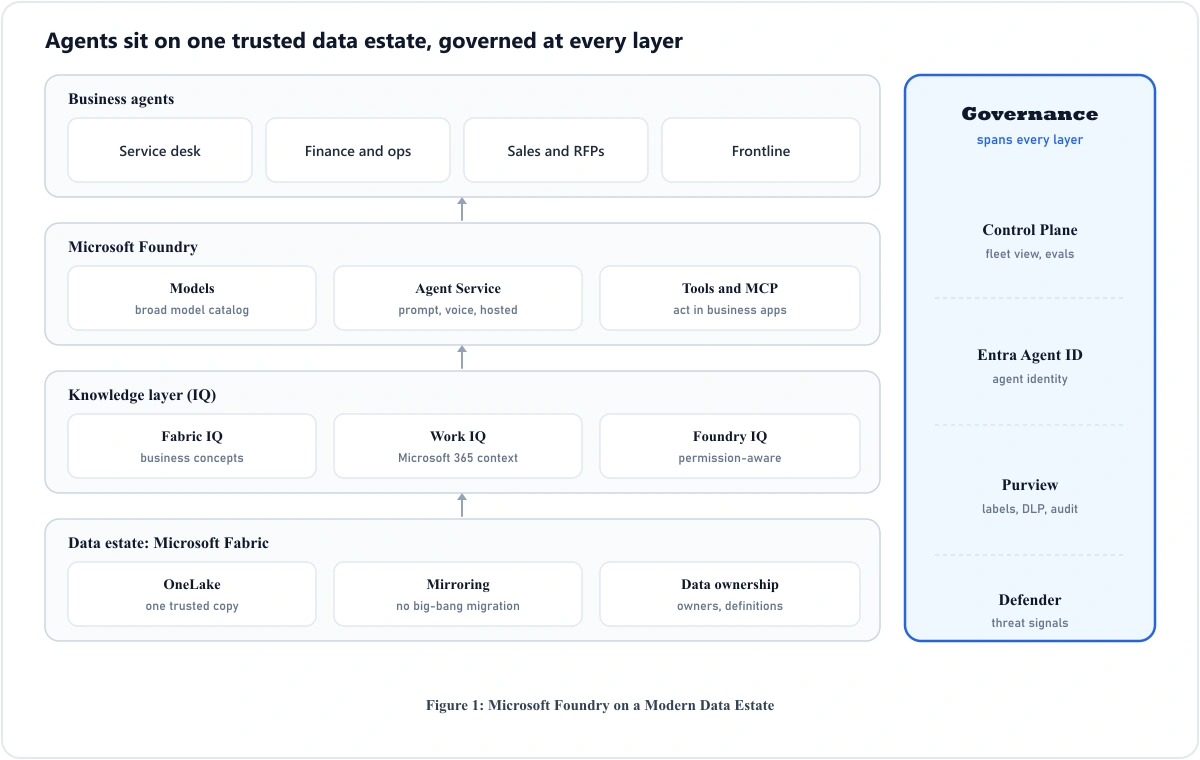
Microsoft Foundry brings models, agents, tools, knowledge, and governance together under one Azure resource. For an SMB, that is less an architecture decision than a staffing one. A small team gets enterprise-grade plumbing without having to stitch together a dozen separate services. The platform rests on five supporting pillars:
- Foundry Models: a broad catalog of models from Microsoft, OpenAI, Anthropic, Meta, Mistral, and others, so each task can use a model priced to match it.
- Foundry Agent Service: prompt agents built in the portal, voice agents, or hosted agents running custom code on frameworks such as Microsoft Agent Framework and LangGraph.
- Foundry IQ: a managed knowledge layer that connects agents to SharePoint, OneLake, Azure Blob Storage, and the web, replacing hand-built retrieval pipelines.
- Foundry Tools and MCP: built-in tools, memory, and the Model Context Protocol, so agents can act in business systems, not just answer questions.
- Foundry Control Plane: one place to see, secure, and govern every agent, model, and tool.
The commercial model suits SMBs too. Foundry services are billed pay-as-you-go, so AI becomes an operating cost that grows with the value it delivers, not an upfront bet.
Grounding Agents in Trusted Enterprise Data
Foundry's strongest argument for SMBs is what sits underneath it. Microsoft Fabric and OneLake hold one trusted copy of the business's data. You can bring in priority sources through mirroring and shortcuts, without a risky big-bang migration.
On top of that, three knowledge layers give agents real context. Fabric IQ organizes data around business concepts such as customers, orders, and assets, not raw tables. Work IQ adds context from Microsoft 365 documents, meetings, and chats. Foundry IQ then turns all of it into a knowledge base that agents can query.
The result is an agent that understands the business like a seasoned employee. It knows what a "key account" means, which price list is current, and where the latest policy lives.
This is also where reuse begins. A knowledge base built for a customer service agent can serve a sales agent next quarter. Each new agent starts from shared, governed data instead of a fresh pile of exports. That is how an SMB stops rebuilding the same pilot and starts compounding its investment.
From Pilot to Production: A Practical Path
Most SMBs weigh three paths to AI agents. A do-it-yourself stack built from open-source frameworks offers freedom, but the team must build and maintain every retrieval pipeline, permission check, and safety filter. Point-solution copilots are quick to switch on, but each one sees only its own data and brings its own security model. Both can work for one agent. Neither holds up well at ten. A governed platform is built so that the second agent is cheaper and safer to build than the first.
| Criteria | DIY Open-Source Stack | Point Solution Copilots | Microsoft Foundry |
|---|---|---|---|
| Time to First Agent | Weeks to months | Days, for the vendor's use case only | Days, with prompt agents in the portal |
| Access to your own Data | Custom pipelines per source | Only the data inside that app | Foundry IQ over SharePoint, OneLake, Blob and the web |
| Model Choice | Any, each integrated separately | Fixed by the vendor | Broad catalog in one place |
| Identity & Permissions | Built and maintained in-house | Per app, fragmented | Entra Agent ID; permissions enforced at query time |
| Data Protection | Depends on in-house skills | Varies by Vendor | Purview Labels, DLP and audit extend to prompts |
| Safety & Monitoring | Add-on libraries, self-assembled | Opaque; vendor dashboards only | Guardrails, Defender signals, continuous evaluations |
| Cost-Model | Low license cost, high people cost | Per-seat subscriptions that multiply | Pay-as-you-go per service |
| Best Fit | Teams with deep ML engineering | One narrow, well-defined task | SMBs scaling several agents on shared data |
SMBs do not need a grand AI program to start. They need a sequence where each step builds data and governance assets the next one reuses:
- Modernize the data behind one process. Bring it into OneLake, assign an owner, agree on definitions, and apply sensitivity labels.
- Ground the first agent. Choose a high-volume, low-risk task, such as internal policy questions or order status, and build it on a Foundry IQ knowledge base.
- Govern before you scale. Register agents with Entra Agent ID, enable guardrails, set evaluation thresholds, and measure impact from day one.
- Scale to connected agents. Reuse knowledge bases, connect agents to business systems through MCP, and let them hand off work to each other and to people.
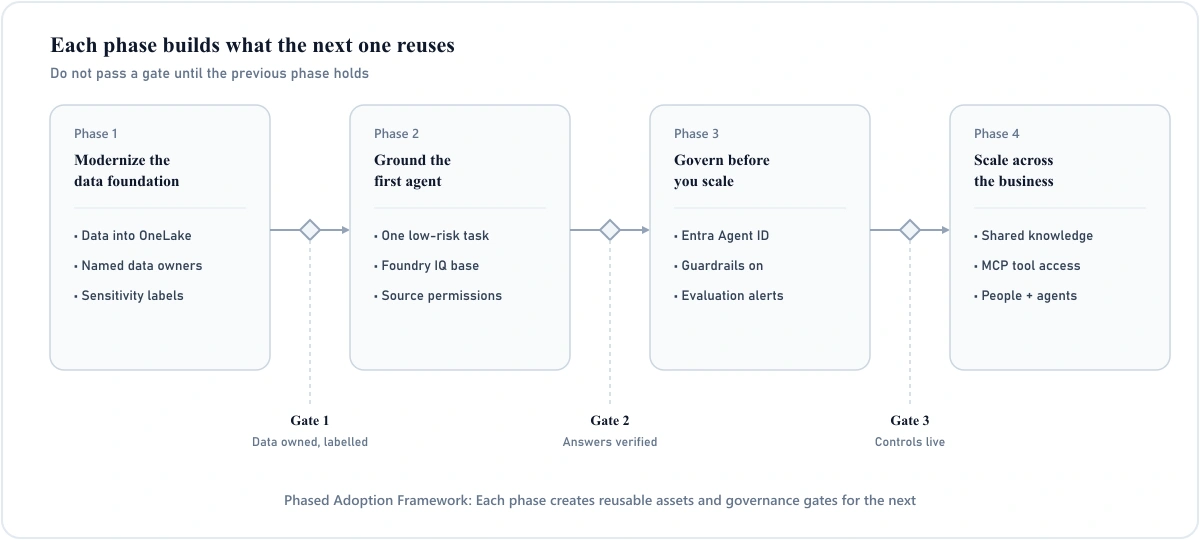
Each gate is a simple test: do not move on until the data, the answers, and the controls of the previous phase are in place. The first use cases should sit on data the business already owns: customer service, invoice reconciliation, proposal drafting and frontline support. An experienced Microsoft Partner can shorten each step considerably.
Final Words
The AI race is not decided by size. It depends on how well a business turns its own data into decisions and actions, safely and repeatedly. Large enterprises reach that point with dedicated teams. Microsoft Foundry gives SMBs a way to get there with the platform doing much of that work. Fabric and OneLake unify the data. Foundry IQ grounds agents in it with permissions intact. Foundry Agent Service turns it into working agents, while Control Plane, Entra, Purview and Defender keep each one accountable. The next step is deliberately small: pick one process, modernize the data behind it, and ship one governed agent. Done well, that first agent becomes the template for the next ten.
👉 Need a partner for the journey? Vortiqo’s Data Modernization & AI Services take you from data foundation to governed agents, one phase at a time.

Anand Rao
Lead Architect – Cloud & Infrastructure
Anand Rao is the Lead Architect for Cloud & Infrastructure at Vortiqo Technologies, specialising in sharing practical insights for IT leaders navigating hybrid and multi-cloud journeys. With over a decade of experience driving digital transformation, he writes about cloud strategy, modernising infrastructure, and the future of enterprise tech.